

Nutrients: Natural polyphenols bring new hope for atopic dermatitis
Atopic dermatitis (AD) is a chronic inflammatory skin disease characterized by skin barrier dysfunction, microbial dysbiosis, and immune disorders. Its clinical manifestations include severe itching, erythema, lichenification, and scaly plaques, which seriously affect the patient's sleep quality and mental health, and even lead to social isolation and emotional disorders. Although the emergence of biologics and targeted drugs has significantly improved the effectiveness of AD treatment, some patients still face adverse reactions and poor long-term efficacy. Therefore, exploring safe and effective adjuvant therapy strategies has become a hot topic in clinical research. Recently, a latest review published in the journal Nutrients systematically integrated 179 pieces of research evidence, revealing the multiple mechanisms of action and clinical potential of plant derived polyphenolic compounds in AD treatment.
AD patients have abnormal lipid composition in the stratum corneum, with a decrease in the proportion of ceramides, especially long-chain ceramides (EOS), leading to increased transcutaneous water loss (TEWL) and increased susceptibility to allergens. Polyphenols can enhance skin barrier integrity by upregulating the expression of key structural proteins such as filaggrin, chitin, and endocytoin, while promoting the activity of ceramide synthase. Research has shown that drinking green tea for 12 consecutive weeks can reduce TEWL by 12% in subjects, and resveratrol can directly stimulate keratinocyte differentiation and lipid production by activating the S1P signaling pathway.
In addition to directly acting on the skin, polyphenols also exert systemic regulatory effects through the "gut skin axis". Polyphenols interact bidirectionally with gut microbiota: on the one hand, gut microbiota metabolizes 90-95% of unabsorbed polyphenols in the small intestine into biologically active phenolic acid derivatives; On the other hand, polyphenols, as prebiotics, can selectively promote the growth of short chain fatty acid producing bacteria such as lactobacilli, bifidobacteria, and Ackermann bacteria, and inhibit the proliferation of pathogenic bacteria such as Helicobacter pylori and Escherichia coli. Apple peel polyphenols can significantly improve the diversity of gut microbiota in mice, reduce the ratio of Firmicutes/Bacteroidetes, and the metabolite 3,4-dihydroxybenzoic acid of quercetin also has skin photoprotective and anti-inflammatory effects.
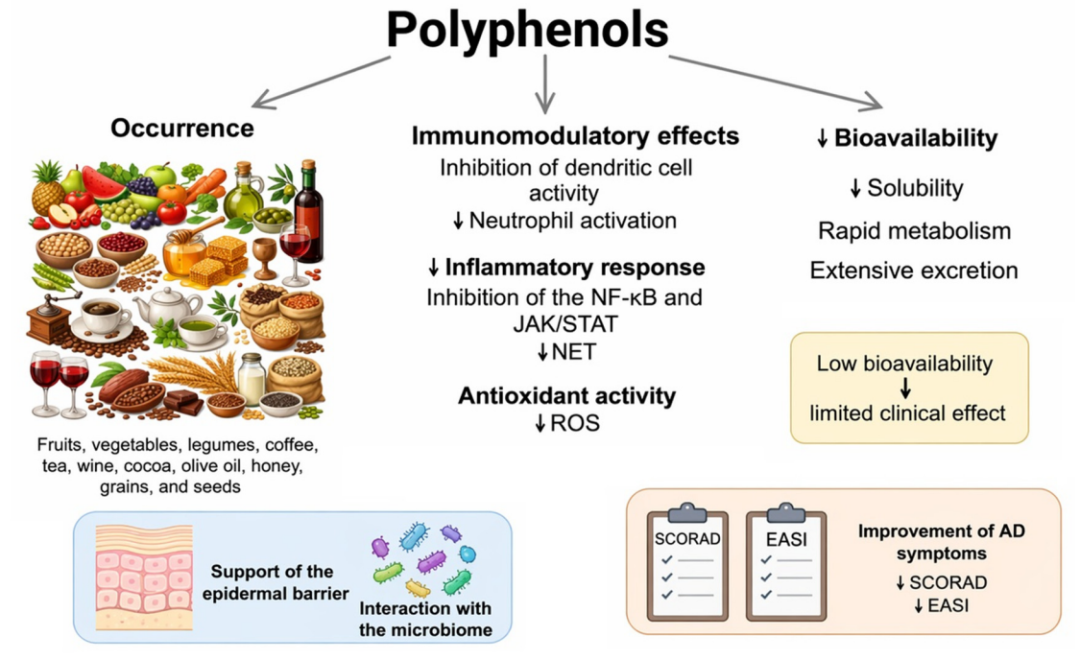
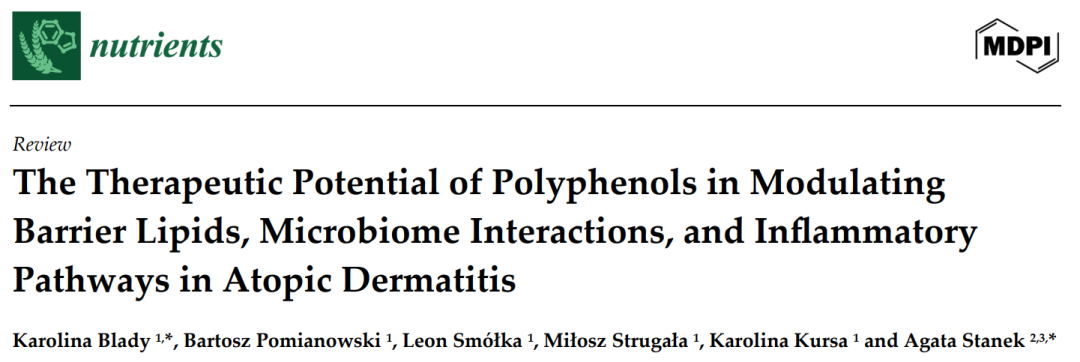
Figure: Overview of the occurrence, biological mechanisms, and limitations of polyphenol bioavailability
In terms of immune regulation, polyphenols inhibit key inflammatory pathways such as NF - κ B and JAK/STAT, reduce the secretion of Th2 cytokines such as IL-4, IL-5, IL-13, and lower levels of immunoglobulin E (IgE) and infiltration of mast cells and eosinophils. Different types of polyphenols have their own advantages: flavonols (such as quercetin) have both barrier repair and anti-inflammatory effects, flavonoids (such as apigenin and luteolin) mainly relieve itching symptoms, and flavan-3-alcohols (such as EGCG) can inhibit the proliferation and biofilm formation of Staphylococcus aureus, reducing programmed necrosis of keratinocytes.
Although animal model studies have shown that polyphenols can significantly reduce the severity of AD like skin lesions and improve SCORAD and EASI scores, clinical translation still faces multiple obstacles. The bioavailability of polyphenols is generally low, with only 5-10% being absorbed into the liver, and there are significant differences among different types. Isoflavones and gallic acid have better absorption, while anthocyanins and catechins have poorer absorption. In addition, the therapeutic effect of polyphenols is dose-dependent, and high doses may lead to adverse reactions such as thyroid dysfunction, reduced iron absorption, and drug interactions. At present, there is a lack of standardized dosing regimens and large-scale randomized controlled clinical trials, which limits its clinical application.
In summary, polyphenols provide a safe and effective adjunctive treatment option for Alzheimer's disease through a triple mechanism of repairing the skin barrier, regulating gut microbiota, and inhibiting inflammatory pathways. Future research should focus on the development of advanced delivery systems such as nano carriers and hydrogels to improve bioavailability, carry out large sample clinical trials to determine the optimal dose and course of treatment, and further explore the regulatory effect of polyphenols on new targets such as mitochondrial autophagy, so as to promote its clinical application from the laboratory.
Original source
Blady, K.; Pomianowski, B.; Smółka, L.; Strugała, M.; Kursa, K.; Stanek, A. The Therapeutic Potential of Polyphenols in Modulating Barrier Lipids, Microbiome Interactions, and Inflammatory Pathways in Atopic Dermatitis. Nutrients 2026, 18, 1365. https://doi.org/10.3390/nu18091365

Online hours: 9:00-17:30
Building 3, High tech Entrepreneurship Service Center, No. 82 Huayuan West Road, Chuzhou City, Anhui Province

Technical Consulting

Customer Service Inquiry
COPYRIGHT © Anhui Cranberry Hea-Tech Co.,Ltd. ALL RIGHTS RESERVED
Power By:Mingtu Network
address:Building 3, High tech Entrepreneurship Service Center, No. 82 Huayuan West Road, Chuzhou City, Anhui Province
mailbox:sales@ffingredients.cn